21 July 2013

"We Must Protect Our Souls With the Sword of the Spirit"


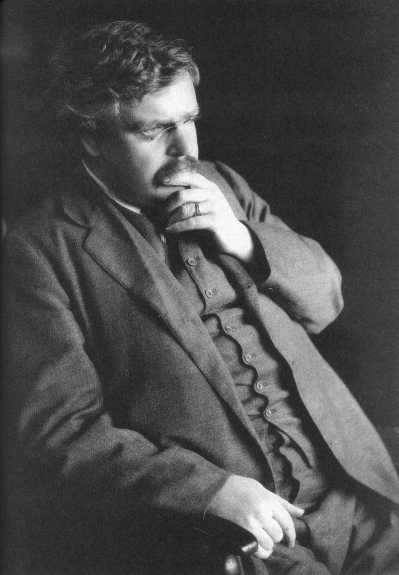
"Ann Veronica is not an immoral book in any imaginable sense; but that is not the primary point. The primary point is that, that it is no business of the State or of any coercive power to suppress immoral books. The business of any coercive and collective power is to suppress indecent books; books that violate fixed verbal and physical custom in such a way as to be a public nuisance. We have a right to be guarded against bodily indecency as against bodily attack; but do not let us call in the police to protect our souls; we must protect our souls with the sword of the spirit. If once I am to test books by whether I think them profoundly and poisonously immoral, I could furnish a very long list to the police. I should at once ask the magistrates to forbid the sale of Froud's History of England, Burke's French Revolution, Hobbes's Leviathan, Smiles's Self-Help, Carlyle's Frederick the Great, all the works of the Imperialists, Eugenists, Theosophists, and Higher Thinkers, and at least half the works of Socialists and of Jingoes. If once we begin to speak of whether things do harm to men's souls, our Index Expurgatorious will begin to fill the British Museum. Ann Veronica  does not urge immorality; it does not urge anything; it intentionally ends with a note of interrogation. I myself even read it as a note of irony; the upshot of the tale, if anything, seemed to me to be rather against modern revolt that in its favor...But the question is not whether my spiritual version is correct; the question of indecency is, comparatively speaking, a question of fact. And the fact is that the book is no more indecent than Bradshaw...Suppose that it were (as it is not) spiritually evil; suppose it were as profligate as Froude or as foul as Smiles and Self-Help, the point is that these spiritual repugnances must not be enforced politically, or we shall lose the very name of freedom."

-G.K. Chesterton, Daily News, 12 February 1910 (via Gilbert Magazine) 

06 July 2013

'Catholic and Bookish': Lumen Fidei, Libraries, and the New Evangelization


I'm still working my way through Pope Francis' new encyclical, Lumen Fidei. It's nice to pause between sections to really drink up the whole thing. I love when new encyclicals are released-nothing like some new fresh breath to revitalize us. And thanks to the wonders of the internet, we all flock to the virtual watering-holes to excitedly share what we're reading. As one friend of mine pointed out, it's like a virtual Harry Potter release party...only with encyclicals. We all wait giddy with anticipation, and then rush to read the whole thing immediately. Technology enables us to share the faith with greater speed and facility than ever before. It's a shame that Brandon Vogt's eagerness to share the new encyclical in e-reader formats was suspended so quickly...but I guess even the Good News is subject to quibbles over distribution rights these days. 

Then, today, I was delighted to see that some friends of mine have banded together to encourage people to request that a print copy of Lumen Fidei  be added to the collection at their local public library. I hope that many more people decide to do the same. I'm especially excited to see this happen because it strikes many chords with things I've previously written about evangelization and libraries. I think we all spend so much time tinkering around on the internet and caught up in discussion of 'the new evangelization' that we forget that books have a tremendously important role to play in spreading the faith-after all, "tolle lege" got St. Augustine's conversion going, and as St. Josemaria once said, "Reading has made many saints."

I think it's relevant here to revisit the words of Mr. Thomas Loome (of Loome Theological Booksellers fame) as he highlighted the great destruction of many Catholic library collections in the wake of Vatican Council II:
"The only other lesson that occurs to me is this: as believing Catholics we have a responsibility to preserve the patrimony of the Church, certainly in so far as it has been entrusted to us as librarians and as professionally interested parties. Much has been destroyed forever. Those who wreak the damage have mostly passed from the scene (although one would like to think that in the end they acknowledged their wrongdoings and perhaps clothed themselves in sackcloth and ashes). And so only we, presiding over the wreckage, are left to tell the tale. 
"What is the lesson for us? To start afresh. Slowly to recreate, in some small measure, what is gone forever. We shall do this, however, only if we are both Catholic and bookish: commmited to the Church, passionately devoted to books, and, as a consequence, deeply rooted in the Church's literary and theological tradition. This is the indispensable condition for an even tolerable future for Catholic libraries. Absent this profound commitment to Catholicism and books, I frankly see virtually no hope at all for Catholic libraries."

05 July 2013

Lumen Fidei

"Faith is born of an encounter with the living God who calls us and reveals his love, a love which precedes us and upon which we can lean for security and for building our lives. Transformed by this love, we gain fresh vision, new eyes to see; we realize that it contains a great promise of fulfillment, and that a vision of the future opens up before us."

-Lumen Fidei

It's here! Nothing like a new encyclical to get the weekend rolling. Click the image below to read online or download in several formats, including an ebook!


And if that wasn't enough, we're also getting two new papal saints this year!

09 June 2013

The Roman Canon, Comfort, and the Communion of Saints


Of all the variations of liturgy that we hear today, the one that puzzles me the most is a habitual over-use of Eucharistic prayers that omit the Roman Canon. I always tend to notice this acutely when I'm in a spell of loneliness, as I was recently. There are many things the mind and spirit strive to do when one is craving company, and at the right moments, the reassurance of needed friends can be found in the persons of the imagination, only found in the fictions of stories. Thus, books can sometimes be a welcome antidote to loneliness, providing us with an invisible sustaining comfort. But often books cannot cure the problem. I recently found myself in a funk that would not be appeased by stories of any kind, their comforts more illusory than ever. Both the beauty and curse of books (and television) is that they cannot talk back.

But without fail, I was relieved (as always) when I went to Mass and heard:

"...the glorious ever-Virgin Mary, Mother of our God and Lord, Jesus Christ, and blessed Joseph, her spouse, your blessed Apostles and Martyrs, Peter and Paul, Andrew, James, John, Thomas, James, Philip, Bartholomew, Matthew, Simon, and Jude; Linus, Cletus, Clement, Sixtus, Cornelius, Cyprian, Lawrence, Chrysogonus, John and Paul, Cosmas and Damian, and all your Saints..."

And if that wasn't enough:

"...graciously grant some share and fellowship with your holy Apostles and Martyrs; with John the Baptist, Stephen, Matthias, Barnabas, Ignatius, Alexander, Macellinus, Peter, Felicity, Perpetua, Agatha Lucy, Agnes, Cecilia, Anastasia, and all your Saints; admit us, we beseech you, into their company..."

And just like the crucial cheering party towards the end of a race, here is the roll call of the Church Triumphant, reminding me that I am far from alone. There are real stories-the most spectacular stories-of saints and martyrs, that we don't have to imagine. There is a certain virtue of the imagination that we need to practice faith and hope, but it is an in sufficient substitute. The written word can rightly act as a catalyst for true comfort, but in the end, the Word that became flesh gives us to most real reassurance.