30 March 2012

Newman on Reading

"It is our duty to live among books, especially to live by ONE BOOK, and a very old one."
-Bl. John Henry Cardinal Newman, Tracts for the Times, no. 2

Giussani on Imagination

"To have imagination means to be able to see the world in its totality."

-Fr. Luigi Giussani, At the Origin of the Christian Claim


27 March 2012

Day of DH: Thomistic Roots

I shouldn't be blogging at all today with a paper to finish, but as I logged into my feed reader today I realized it is Day of DH. For those of you who are non-librarians, Day of DH is a day when digital humanists around the world spend some time documenting what they do, usually by blogging or shout-outs in the Twitter-sphere. I'm not a digital humanist, but I have a marginal interest in DH activities, especially because I'm interested (as any archivist who wants to survive the future) in digital archiving and  preservation. There are a lot of really cool DH projects out there, done by both scholars and non-academics. One of my favorites is the Rosetti Archive (it's cool to see the poems and art of a poet-artist juxtaposed on the same page). Despite some attitudes to the contrary, the humanities are not dead, and technology is only helping to re-vitalize them.

One interesting piece of trivia about digital humanities, humanities computing, or whatever you want to call it, is that it has Jesuit origins. Fr. Robert Busa, S.J., collaborated with IBM to conduct linguistic analysis on the works of St. Thomas Aquinas, resulting in the production of the Index Thomisticus. Fr. Busa, bless his heart, spent years working with punch cards to produce this. He began this not in the 1980s, nor the 1970s, but 1949 (!). He is known as an early pioneer in digital humanities, and his death last year was a loss for the international DH community. So take a few minutes today to see what is happening in DH!

Fateful meeting with St. Thomas: a drawing from Fr Busa's last Christmas card (2010).

On Twitter: #DayofDH

25 March 2012

Holy People Reading, Annunciation Edition

The Virgin Mary, Ghent Altarpiece. Hubert van Eyck, 1432
The Virgin Mary Reads (at least in Christian art).

Happy [early] Feast of the Annunciation!

24 March 2012

Intolerance, Censorship, & Other Requirements of Rationality

From time to time I will likely reflect on censorship here, because it is an issue that demands more nuanced examination in the modern library landscape. Not, however, the kind of attention that library advocates usually give to it. Most of the library world (in my view) has a visceral reaction to any mention of "censorship," as if its very name was capable of beckoning twisted Inquisitionists back from the dead to steal our freedoms (I silently roll my eyes every time I sit in an LIS class and hear my professor ask us rhetorical questions about our opposition to censorship). Library advocates, most notably the American Library Association, are decidedly opposed to censorship in any form. The ALA's Library Bill of Rights states:
III. Libraries should challenge censorship in the fulfillment of the their responsibility to provide information and enlightenment.
So there is a general patent assumption that censorship is intrinsically bad and an impediment to intellectual freedom. (My local public library even recently re-affirmed its decision to not filter p*rn on its computers, in the name of not invading patron privacy, and I guess, avoiding the expense of filtering software). Considering popular historical associations with censorship, such as government and school banned books lists, and the reputed Index Librorum Prohibitorum, issued by the Catholic Church, any discussion of censorship still carries significant political and emotional charges. 
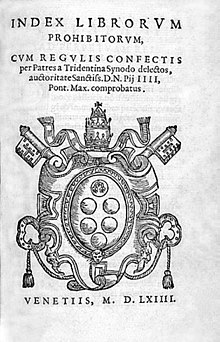


I don't think we ought to up and start banning books again, but I do think that the ALA's outright opposition to censorship is an erroneous position. I also think that many librarians need to re-think their approach to public service in regards to serving patron 'wants'. This may have more bearing on personal philosophy than on library policy, but trusting too much in Enlightenment values can be an obstacle to intellectual freedom in itself.