
Showing posts with label Ridiculousness. Show all posts
Showing posts with label Ridiculousness. Show all posts
25 March 2014
The Gilmore Challenge
I can't say I entirely agree with all of Rory's tastes, but it's hard not to be delighted that Australian writer Patrick Lenton has compiled a comprehensive list of every book mentioned in the series run of Gilmore Girls. Over seven seasons, the total is over 300. That averages to about 49 books per year, or roughly one per week. Life of Johnson certainly isn't helping me keep pace! Quality over quantity.

26 February 2014
Librarian Problems...
When your friends mistake John Dewey and Melvil Dewey for the same person:

No, the Dewey Decimal System is not part of some pragmatist philosophical conspiracy. It's actually pretty great.
22 July 2013
Staying for the Credits: The Problem of Reverence

I absolutely love going to the movie theater alone. To me, there is no pleasure quite like attending a late Saturday morning matinee, free from the gaggling primetime crowds-- just me, the film, and about three other quiet pleasure-seekers, all silently brimming with excitement as we enter our nearly empty sanctuary. I've always been told that I'm a picky movie-goer-I'm one of those people who scowls at animated crowd reactions and insists on staying until all the credits have rolled (usually out of principle to give everyone the credit they deserve, but also secretly to see if this film is the one out of every few dozen that rewards our loyal patience with a brief post-script). Call me a scrooge, but remaining silent for two hours inside a dark theater shouldn't be too much to ask (especially at today's ticket prices). I usually explain my movie-going rituals in terms of the receptivity required in order to fully experience art in any form-it can be difficult to truly observe the drama in front of our eyes if we are preoccupied with instantly responding to it. The film can too easily be replaced by meta-experience, and we miss some of its richness. Not every film is a bastion of moral seriousness or provocative texture, but I always thought it was quite obvious that we go to the theater to engage ourselves with a story-not to listen to ourselves talk. We can't fully take part in the adventure unless we let ourselves sink back into the woodwork and let the drama take center stage.
18 January 2013
Life [Kind of] Resembling Art
Inevitably, the simplest default explanation of the archival profession to an outsider:

With one notable exception: I refuse to idolize Masons.
02 January 2013
Life is a Mystery...
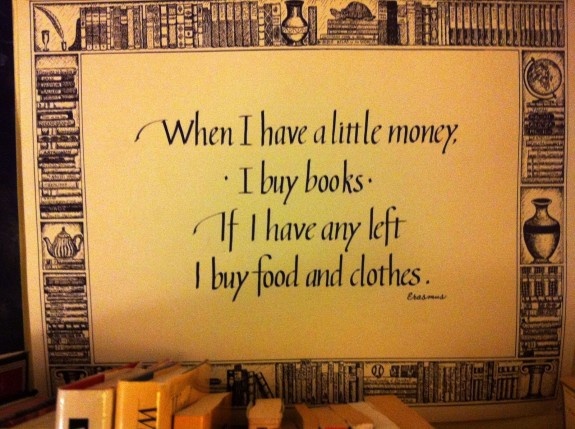
H/T Brandon Vogt.
Fortunately, the quotation above doesn't significantly apply to me (but I do avoid shopping malls like the plague and only cook because I would starve otherwise). All in all, I am a pretty temperate book-buyer. I add to my personal library in small bits, but I make extensive use of libraries, and occasionally borrow interesting titles from friends. Goodness knows I would love more books. Yet every Christmas I am left in a familiar state of bewilderment when I am given no new tomes to carry gleefully home.
I know it is vain to complain about gifts. But yes, you heard that right-my family, my own dear family, rarely gives me books as Christmas gifts.
02 December 2012
Book Apocalypse-Not Now
Almost as soon as e-books came on the scene, there have been talks of the demise of the book as we have long known it. These doomsday predictions are far from being true. While rapid technological reform (a more accurate term than 'progress' I think) has become the norm in today's world, it is far too soon to make such a forecast about books. E-books have been on the market in a significant way since just the mid-2000s; the codex has existed in virtually unchanged form for more than 1,500 years. In just that short time, we have already discovered that the amazing convenience and storage capacity of e-readers come with a price, with draconian (i.e. anti-sharing and ownership) DRM policies and rapid generational updates ensuring that e-readers function without some of the most useful features of the traditional codex.

While I am quick to refute those who claim the traditional book has run its course, I am often disappointed by the overly-sentimental apologias that are usually put forward by defenders of the traditional codex. The chorus of sappy humanists defending books on the basis of emotional significance and sensory experience (see here and here) does contain a few grains of truth, but books don't need such a subjective appeal in their defense. It makes for nice drama and all, but the traditional codex will not continue to endure because of its emotional power (or use as an ironic prop), but rather due to their remarkable technological persistence. The practical value of books lies in their function and design-not aesthetics.
24 November 2012
Shillelagh Saturday; Or, How I Really Feel About Touchdown Jesus
 |
| Deo gratias. |
While part of me stands in strong solidarity with those who are sickened by the excessed of collegiate athletics, I also cannot deny that a winning football team also reaps rewards for the libraries and academic programs of the schools involved. Whatever skepticism I may still have about head coach Brian Kelly, his arrival gift to university libraries and research made me slightly more receptive to his style. And as much as getting to the National Championship game would make any alum's heart sing, the thought of the libraries receiving their share of the $6.2 million BCS payout, win or lose at USC, is enough on its own to make this librarian happy.
Notre Dame's library has also been fatefully synonymous with the football program since the completion of the Word of Life mural on the facade of the current library building in 1964, popularly known as "Touchdown Jesus," which can be seen peeking out from behind the North end of the football stadium.

Now I have a big confession to make:
I am not, by any stretch of the imagination, a sentimental lover of Touchdown Jesus.
15 November 2012
Some Things Never Change...
What my office looks like to non-archives corporate staff:

What my office looks like to me:

Who thought that a mere pile of boxes could be the cause of such shock and awe?
03 October 2012
Wherein I Rant about Banned Books Week
It is that time of year again. The week when nearly every librarian and their brother give enthusiastic exhortations to "Read Banned Books!" and proceed to superficially discuss the importance of 'intellectual freedom.'

It would be an understatement to say that I am deeply exasperated by the annual celebration of Banned Books Week. Like a lot of other ALA advocacy efforts, it is emotionally charged, politically correct, and does not facilitate a rich discussion of the issues it aims to address. I hope this post enables a bit of that discussion. My heart was warmed earlier this week by a post from Annoyed Librarian which addresses the mis-direction of Banned Books Week. Like many modern librarian activities, it involves a healthy dose of pretend progressivism:
In regards to the discussion of intellectual freedom and 'spreading awareness' about the lingering impact of censorship in today's libraries, I am almost always disappointed by the tone of articles, blog posts, etc. that inevitably end in a disparagement of so-called 'inquisitionist' or 'crazy' parents who wish to thrust their mind control upon the rest of society. While it is true that virtually all instances of what are now colloquially referred to as 'book banning' are mere challenges placed by individual parents in school or public libraries, many parents who submit such challenges do so with the good intentions of properly stewarding their children's media consumption. I still think it is naive of them to presume that all libraries, even the children's section, are completely tailored to their value system and parenting methods, and also think it is silly to think that said libraries should be punished just because you did not double-check junior's book bag. Nonetheless, this is the very population of 'pro-censorship' people that Banned Books Week Advocacy seems to be aimed at, yet I rarely hear anyone charitably engage book-challenging parents in a logical dialog about why censorship might be problematic. Such respect is often feigned, albeit well, by reference desk staffers with short tempers. Usually what one hears is akin to "Stop being difficult. You are annoying. We are right. You are wrong. Read banned books!"So much for library neutrality.
Aside from its feigned radicalism, my two biggest criticisms of Banned Books Week are 1) that it only perpetuates myths and misconceptions of censorship rather than educating the public about reality and 2) its false subversiveness and one-dimensional slogan do not encourage the public, whether young or old, to critically examine their attitudes about reading and media consumption.
It would be an understatement to say that I am deeply exasperated by the annual celebration of Banned Books Week. Like a lot of other ALA advocacy efforts, it is emotionally charged, politically correct, and does not facilitate a rich discussion of the issues it aims to address. I hope this post enables a bit of that discussion. My heart was warmed earlier this week by a post from Annoyed Librarian which addresses the mis-direction of Banned Books Week. Like many modern librarian activities, it involves a healthy dose of pretend progressivism:
"This is such a typically radical librarian thing to do: pretend to be subversive and daring by doing something that's not remotely prohibited by law, including some apparently xenophobic laws in Arizona. Unless the underground librarians are planning to sneak into classrooms and start teaching kids Sandra Cisneros, all the feelgood drama is completely unnecessary."As someone who doesn't abide by the ALA's fake subversiveness, I guess I get a prize for having a truly radical librarian view (?).
In regards to the discussion of intellectual freedom and 'spreading awareness' about the lingering impact of censorship in today's libraries, I am almost always disappointed by the tone of articles, blog posts, etc. that inevitably end in a disparagement of so-called 'inquisitionist' or 'crazy' parents who wish to thrust their mind control upon the rest of society. While it is true that virtually all instances of what are now colloquially referred to as 'book banning' are mere challenges placed by individual parents in school or public libraries, many parents who submit such challenges do so with the good intentions of properly stewarding their children's media consumption. I still think it is naive of them to presume that all libraries, even the children's section, are completely tailored to their value system and parenting methods, and also think it is silly to think that said libraries should be punished just because you did not double-check junior's book bag. Nonetheless, this is the very population of 'pro-censorship' people that Banned Books Week Advocacy seems to be aimed at, yet I rarely hear anyone charitably engage book-challenging parents in a logical dialog about why censorship might be problematic. Such respect is often feigned, albeit well, by reference desk staffers with short tempers. Usually what one hears is akin to "Stop being difficult. You are annoying. We are right. You are wrong. Read banned books!"So much for library neutrality.
Aside from its feigned radicalism, my two biggest criticisms of Banned Books Week are 1) that it only perpetuates myths and misconceptions of censorship rather than educating the public about reality and 2) its false subversiveness and one-dimensional slogan do not encourage the public, whether young or old, to critically examine their attitudes about reading and media consumption.
20 September 2012
Embarassing Faux Pas of the Searching [Library] Employer
It amazes me that career advice columnists manage to survive. I am not sure if I am alone on this. But every time I see a new headline for '10 Things to Never Say in an Interview' or '5 Ways to Make Your Resume Shine,' I read the same common-sense or inane advice that has been repeated from time immemorial. Anyway, in libraryland there are many sites dedicated to navigating library school and the hiring process: Hack Library School, I Need a Library Job, Hiring Librarians, and Open Cover Letters. Letters to a Young Librarian also occasionally features some young career advice. Hiring Librarians has a regular feature where hiring manager at library organizations are interviewed about what advice they have for job-hunting candidates, covering everything from preparation and salary negotiation to etiquette and fashion. There should be a similar list for employers.
| In their imaginary fantasy world, library hiring managers probably wish all of their candidates are like Rex Libris. |
One of my favorite job-search related blogs to peruse is You Ought to Be Ashamed, which focuses on the disastrously absurd in archival job postings, a la "Must have an MLS, Ph.D., be fluent in 5 languages, have 7 years programming experience. Salary: $32,000"). Sadly it is not updated that often. But I wish there were more ways for potential employers to improve their end of the job-search. In recent months, I have heard all kinds of embarrassments from job-hunters librarian and non-librarian alike, and one wonders what this world is coming to. To begin, here is a brief list potential employers should avoid.
13 August 2012
Who is John Galt?
Since the announcement of Paul Ryan as Mitt Romney's running mate late last week, the ever-blazing fire of political hysteria has had a fresh burst of fuel. Luckily, we will not discuss politics on this blog. We shall leave that unpleasant pastime to other blogging heads. But what is pressing my buttons is all the hysteria that is being generated about Paul Ryan's relationship with Randian literature. I know very little about the extent and exact nature of the influence of Ayn's canon on Ryan's politics. I have sampled a few anecdotes. Far and wide, people are crying fowl that Ryan has demonstrated positive interest in Rand's works. And then denying their influence on him-or not?
Now really, I could read as much as my puny litter grey matter could handle and I still wouldn't know up from down about the whole truth of the interior life of this country's dear politicians. But suffice it to say, I've already become annoyed at some who have severely recoiled at Ryan's association with Rand, as if reading a book and finding it fascinating and insightful somehow generates incurable Objectivist cooties. Ryan certainly got some measure of excitement from Rand, but his interest does not appear to be fanatical. I don't deny that Rand's Objectivism is downright frightening, but I don't think Ryan's significant engagement with her writing should necessarily alarm folks. I may stand corrected as I do my duty and reluctantly listen to more political banter as this election season progresses, but I think the general public is wrong to use Ryan's Rand connection to impulsively label him an enemy of the people (IMH non-political opinion).
| Really, Atlas is just holding his head in his hands and weeping about the modern state of political discourse. |
01 August 2012

16 April 2012

Subscribe to:
Posts (Atom)